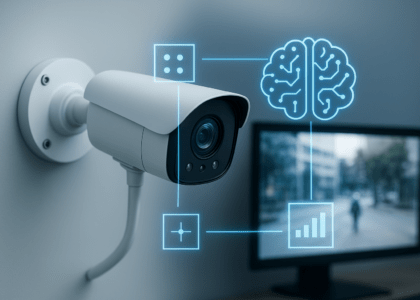
A traditional CCTV camera can watch a burglar climb over your wall, walk across your garden and pick up your television—and still remain completely calm. Very professional. Very useless.
That is because a normal CCTV camera does exactly what it was designed to do: record everything and understand nothing. AI CCTV changes that by analysing what is happening in the video and identifying events that may need human attention
It sees people.
It sees vehicles.
It sees movement.
It records hours and hours of footage.
But ask it, “Did someone just enter a restricted area?”
Silence.
Ask it, “Has that person been standing near the gate for the last 25 minutes?”
More silence.
Ask it, “Is that vehicle going in the wrong direction?”
The camera will basically say, “I have no idea, boss. I just record.”
And this is where AI CCTV changes the game.
Your CCTV Camera Just Got a Brain
Imagine having hundreds of cameras around a factory, school, warehouse, apartment complex or border facility.
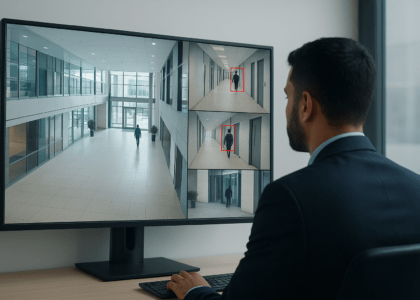
Traditionally, somebody has to watch those screens.
And humans have one tiny problem.
They are human.
They get tired.
They get distracted.
They look away.
They drink tea.
They check their phone.
They blink.
Meanwhile, something important can happen on Camera 47 in the three seconds nobody is looking.
AI CCTV takes a completely different approach.
Instead of simply recording video, AI-powered surveillance systems can analyse what is happening inside the video.
The camera doesn’t just ask:
“Is there movement?”
It can ask:
“What is moving, where is it going, and is that behaviour unusual?”
That is a very big difference.
From “Something Moved” to “Something Is Wrong”
Traditional motion detection is fairly simple.
A shadow moves?
Alert.
A dog walks past?
Alert.
A tree branch moves in the wind?
Congratulations—you have another alert.
A person enters a restricted zone?
Also… alert.
After receiving enough meaningless notifications, people naturally develop a fascinating security technology of their own:
They start ignoring the alerts.
AI can make surveillance much more intelligent by analysing objects, people, movement patterns and predefined zones.
For example, an AI CCTV system could be configured to identify events such as:
- A person entering a restricted area
- Someone crossing a virtual boundary
- A person remaining in a sensitive area for an unusual amount of time
- A vehicle entering a prohibited zone
- A crowd forming unexpectedly
- An object being left behind
- A person falling in a monitored area
- Movement during restricted hours
- Unusual movement patterns
Instead of giving security personnel thousands of hours of video to watch, AI can help bring the important moments to their attention.
The Difference Between Watching and Understanding
This is probably the simplest way to understand AI CCTV.
Traditional CCTV:
“Here is 24 hours of video. Good luck.”
AI CCTV:
“I detected something you may want to look at.”
That difference can completely change how a security operation works.
Imagine a warehouse with 40 cameras.
Without intelligent analytics, reviewing an incident might mean searching through hours of recordings.
With AI-assisted surveillance, the system can potentially flag the relevant event and dramatically reduce the amount of footage that a human operator needs to examine.
The camera keeps watching.
The AI keeps analysing.
And the human makes the final decision.
That last part is important.
AI CCTV should not be thought of as replacing security professionals.
It is better understood as giving them an extra set of extremely patient digital eyes.
AI CCTV Doesn’t Need a Coffee Break
At 2:00 PM, your security team is alert.
At 2:00 AM?
Let’s just say the coffee machine becomes an important member of the security department.
AI doesn’t have that problem.
An appropriately designed AI surveillance system can operate continuously and analyse events throughout the day and night.
This becomes particularly useful for places where security cannot depend entirely on constant human attention.
Think about:
Factories.
A restricted production area can be monitored for unauthorised entry.
Warehouses.
AI can help identify unusual movement around sensitive storage areas.
Schools and colleges.
Restricted zones and unusual crowd activity can be monitored.
Residential communities.
Entry and movement around gates and other designated areas can be analysed.
Construction sites.
After-hours movement can trigger an alert for human verification.
Critical infrastructure.
Sensitive zones can be monitored continuously.
And yes—there are applications where intelligent surveillance can assist security agencies in monitoring large and difficult-to-observe areas.
What About the Border?
Now things get really interesting.
India has thousands of kilometres of land borders, including areas where terrain, weather, darkness and sheer distance make surveillance extremely challenging.
You cannot put a security guard every few metres.
You cannot expect a human operator to stare at hundreds of camera feeds simultaneously.
And you certainly don’t want an important event to become visible only after somebody reviews yesterday’s footage.
AI-assisted CCTV and video analytics can potentially become another layer in a broader border-security architecture.
For example, cameras positioned at strategically selected locations could use computer vision to identify movement within defined areas and generate alerts for human operators.
The objective isn’t:
“Let the AI decide who is a terrorist.”
That would be a dangerous and inappropriate use of automation.
The objective is:
“Let AI help identify unusual activity so trained personnel can investigate faster.”
That distinction matters enormously.
AI should help security personnel see sooner—not decide blindly.
The Most Powerful Feature May Be the Boring One
Everyone gets excited about facial recognition.
But sometimes the most useful AI feature is something much simpler:
Knowing where something is not supposed to be.
Imagine a virtual line drawn across a restricted road.
If a vehicle crosses it at the wrong time, the system can generate an alert.
Imagine a protected perimeter.
If a person crosses the defined boundary, the system can flag the event.
Imagine an industrial facility where nobody should be present after midnight.
If movement occurs inside that zone, the system can bring it to an operator’s attention.
No dramatic Hollywood technology required.
Just cameras, computer vision, clearly defined rules and good security procedures.
AI CCTV Is Not Magic
And this is where we should be honest.
AI CCTV isn’t a magic box.
It can make mistakes.
Bad lighting can affect detection.
Heavy rain can affect visibility.
Fog can make identification difficult.
Camera positioning matters enormously.
Poor network infrastructure can create problems.
And an AI model is only as good as the system around it.
That means successful AI CCTV deployment requires more than simply buying an “AI camera.”
You need the right cameras.
You need appropriate computing infrastructure.
You need intelligent video analytics.
You need reliable connectivity.
You need sensible alert rules.
You need trained personnel.
And, critically, you need privacy, cybersecurity and responsible-use policies.
The Future: Cameras That Tell You What Matters
The future of CCTV isn’t necessarily about installing more and more cameras.
It is about making the cameras you already have more useful.
Instead of humans trying to watch everything, AI can help filter enormous amounts of visual information and bring potentially important events to human attention.
That creates a new model of security:
Camera → AI Analysis → Alert → Human Verification → Action
The camera watches.
The AI analyses.
The human decides.
And the security team acts.
That’s considerably more useful than simply filling a hard drive with 24 hours of video.
So, Is AI CCTV Worth It?
If your current security strategy depends on someone watching dozens of screens all day and hoping nothing important happens while they look away, then yes—it’s probably time to rethink the strategy.
AI CCTV can add intelligence to existing surveillance infrastructure and help organisations move from passive recording to active detection.
And perhaps the funniest part is this:
Your CCTV camera has been staring at the world for years.
It was never actually watching.
Now, we’re teaching it to pay attention.
Want to See AI CCTV in Action?
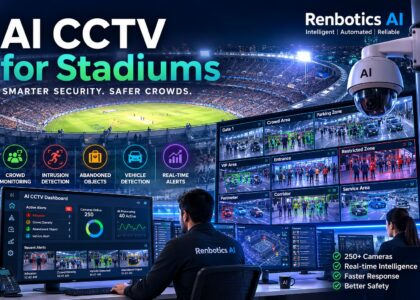
At Renbotics AI, we are developing AI-powered CCTV solutions designed to turn ordinary video surveillance into intelligent, event-driven security.
Instead of asking:
“Did the camera record it?”
we can start asking:
“Did the system notice it?”
And that is where CCTV gets interesting.